The Problem With Waiting for Formal Authority to Start Change
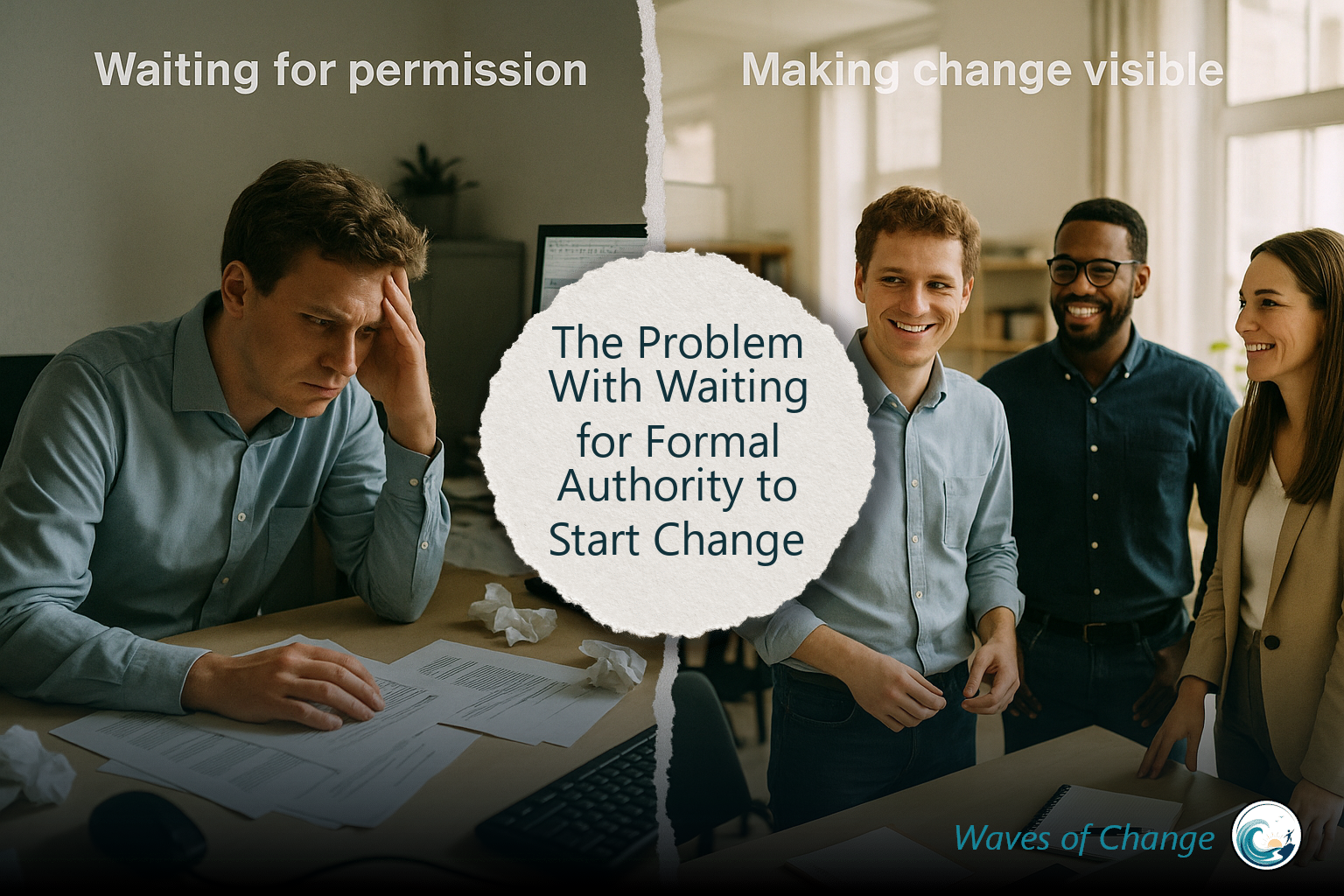
A familiar pattern shows up in many organizations: people can see a better way to work, but they do not move until someone senior approves it, sponsors it, or launches it properly. By the time that happens, the moment that made the change obvious has often passed.
That is not just a timing problem. It is a design problem. Organizations quietly teach people where change is allowed to begin, who is supposed to initiate it, and how much permission is required before anyone dares to act differently. The result is predictable: the people closest to the work wait for a signal that never comes soon enough.
What looks like caution is often a system effect. When an organization makes formal authority the starting point for change, it also makes delay the default behavior.
The pattern underneath the event
The deeper issue is not that people lack ideas. It is that many workplaces have designed change as a top-down event instead of a practical daily behavior.
The message is usually clear, even if nobody says it aloud: do not move too early, do not change the process on your own, do not create noise before the plan is settled. People learn to wait. They wait for the sponsor. They wait for the workshop. They wait for the launch email. They wait for the steering meeting that will turn a loose idea into something official.
That waiting feels responsible. It also leaves a lot of useful action untouched.
In real organizations, the first change rarely begins with a big announcement. It begins with one person doing one thing differently in a meeting, a handoff, a customer conversation, or a decision that used to move by habit. If that first move is blocked until formal authority arrives, the organization has already made the change more expensive than it needs to be.
Design creates behavior
Design is about more than org charts and governance forums. The importance of the small rules people absorb from the way work is handled is often overlooked.
If the design says that change must be approved before it can be tried, people will protect themselves by waiting. If the design says that deviations must be escalated before they can be tested, people will avoid making visible moves. If the design says that only senior leaders can authorize a new way of working, then initiative becomes a risk rather than a contribution.
That is how design shapes behavior. It does not need a policy memo. It only needs repetition.
People become careful. They phrase ideas as questions. They present problems upward instead of solving what they can. They spend time building alignment around a change that could have been made easier to experience in one team, one workflow, or one recurring interaction.
The strange part is that organizations often ask for ownership while designing out the conditions that make ownership possible. They tell people to lead change, but reward waiting for permission. They ask for initiative, but make the first visible step depend on a level of sign-off that is slow, crowded, and distant from the work itself.
Behavior becomes operations
Once people learn to wait, the effects show up in the operating rhythm.
Ideas stall between meetings. Simple improvements get folded into larger programs because nobody wants to move without a formal wrapper. Teams keep using the old route because it is already understood, already approved, and already easier than creating a special case for the new one. Local leaders hold back practical adjustments because they do not want to look out of line.
And so the work stays heavier than it needs to be.
A clearer path might be visible to the person doing the task, but not yet visible to the committee. A shorter handoff might save time immediately, but no one wants to change it before the larger operating model has been blessed. A team may know exactly how to reduce repetition in its own area, yet still wait because the broader change has not been “unlocked.”
That waiting has operational consequences. It keeps unnecessary steps in place. It preserves duplicate approvals. It leaves people working around the process instead of through it. It makes simple improvements harder to copy because the first example was too tied to formal authority to feel available to others.
In practice, this means the organization spends more time coordinating than improving. More meetings. More clarification. More handoffs. More reliance on a few people with enough status to move things forward. The people closest to the work end up carrying the cost of a design they did not choose.
Operations become economics
The economic cost is easy to miss because it rarely appears as one big expense line. It shows up in accumulation.
When people wait for permission to act, the organization pays in delay. Delay slows cycle time, which means opportunities are missed or postponed. It pays in coordination, because more time is spent arranging agreement than removing friction. It pays in capacity, because people keep carrying old work while the new way is still trapped in planning. It pays in quality, because workarounds become normal and exceptions multiply. It pays in morale, because people who can see the problem but cannot move it eventually stop offering useful ideas.
There is also a strategic cost. Organizations that make change too dependent on formal authority become slower at learning. They get better at approvals than at adaptation. That matters when the environment shifts faster than the governance cycle.
A company can afford some delay. It cannot afford to teach everyone that the safest move is to do nothing until someone senior makes the first move for them.
The result is not just slower execution. It is a more expensive organization. Every extra meeting, every delayed decision, every workaround, and every repeated explanation adds cost to change that should have been light enough to test early and adjust quickly.
What this means for change leaders
The practical lesson is simple: do not wait for the whole system to give you permission before you begin making change visible.
That does not mean ignoring authority. It means starting from what you can actually control. In many organizations, the first useful move is not a launch plan. It is a small behavior that others can observe. A better question in the beginning is not, “How do I get approval?” It is, “What can I change in my own behavior, workflow, or decision path so the new way becomes easier to experience?”
This is where change either stays abstract or becomes real. People do not adopt a memo. They adopt what they can see working around them. A change leader who waits for the perfect mandate often arrives too late. A change leader who makes one practical move creates something others can judge, copy, or improve.
That is the useful tension in Waves of Change: change does not spread because it has been decided. It spreads when it becomes easier and more realistic to join than to ignore. The first step is often not to persuade harder. It is to reduce the distance between the old way and the next useful move.
If you want people to move, make the movement visible. Make it small. Make it concrete. Make it possible without a ceremony around it.
A practical question to ask
What is one visible change I can make now without waiting for formal permission?
It is a useful question because it cuts through the habit of postponement. It forces the issue back into the work where it belongs. It also reveals how much of the delay is structural rather than personal. If the answer is “nothing,” that may be a sign that the design itself is blocking initiative. If the answer is “one thing,” then the first move is already available.
That is often enough to start. Not a program. Not a launch. Just a visible shift that makes the new way slightly easier to join than the old one.
Closing reflection
Waiting for authority feels careful. Sometimes it is. But in many organizations it is simply a way of letting the old pattern keep its seat at the table.
Change usually begins earlier than the official plan. The question is whether the organization lets anyone act at that point, or whether it teaches them to wait until the moment has passed.